“STRILA”
BILLIARDS RULES
1. Billiard Equipment
For playing “Strila” billiards, standard billiard tables, cues, and accessories for “Pyramid” billiards are used.
2. Balls for “Strila”
“Strila” billiards uses special balls – Aramith Premier with a diameter of 67 mm (the set includes seven colored balls, as well as the cue ball – the white ball).
3. Start of the Frame
3.1 At the start of the frame, seven colored balls are placed on the foot spot in the shape of an “arrow” (Fig. 1).
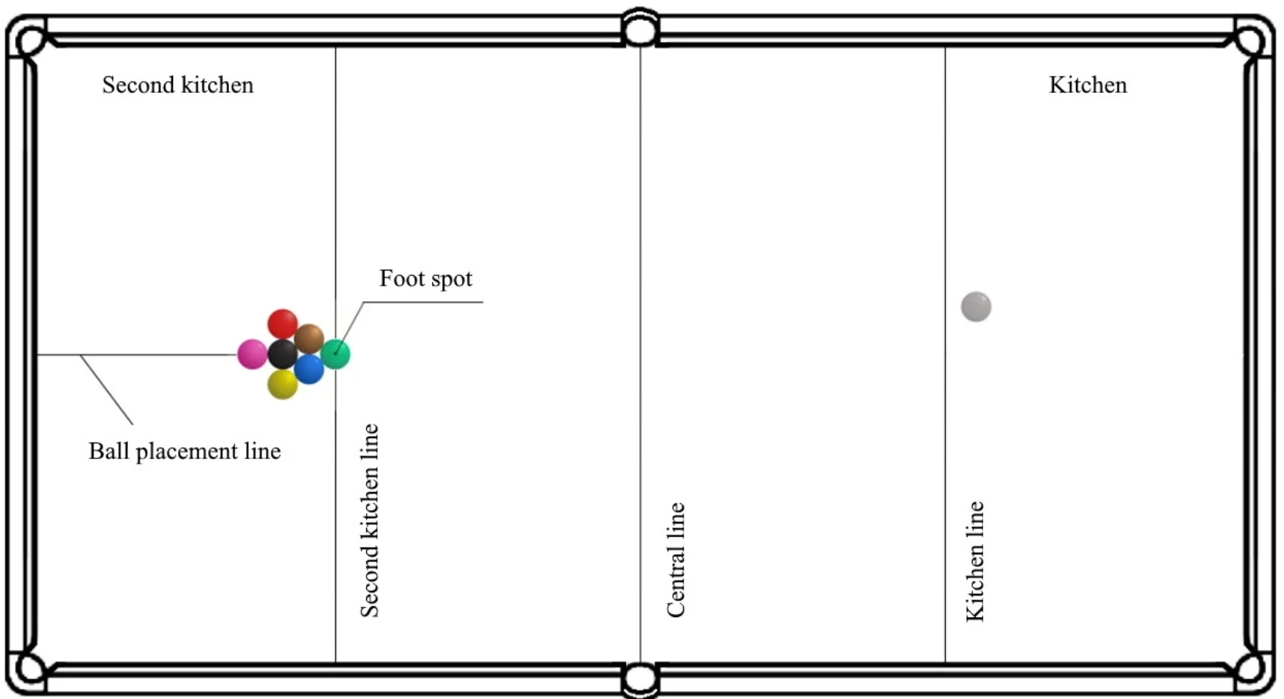
Figure 1 – Example of the initial ball setup
3.2 The black ball is placed in the center of the “arrow”, the other balls are arranged in random order.
3.3 The player who wins the right to the first shot performs the opening break shot from the baulk area (“kitchen”), striking the cue ball into any ball of the “arrow”.
3.4 The break shot must be active (if no ball is pocketed, at least three colored balls must contact a cushion, or two colored balls must contact a cushion and another colored ball must roll across the center line of the playing table). If this does not occur, it is a foul (Clause 13).
3.5 All balls pocketed on the opening break are counted, and the player continues their turn (run).
4. Gameplay
4.1 The game is played with one cue ball (the white ball).
4.2 After the opening break, players must strike first contact of the cue ball with one of the active balls (Clause 6).
4.3 Playing at an active ball, it is allowed to pocket both the cue ball and colored balls (including inactive ones), for which the player is awarded points (Clause 10).
4.4 After pocketing a ball, the player continues their turn (run).
4.5 After a miss or a foul, the right to shoot passes to the opponent.
4.6 Objective: to score more points than the opponent by the end of the frame (Clause 14).
5. Order of Colored Balls

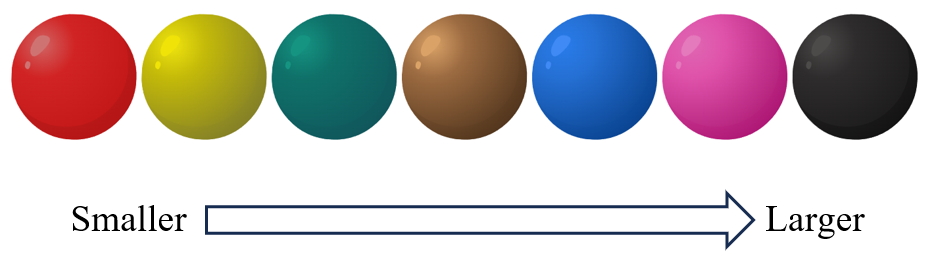
Figure 2 – Order of colored balls
6. Active Balls
Players must strike the cue ball so that its first contact is with one of the active balls. If the first contact of the cue ball is with an inactive ball, it is a foul.
The cue ball may be masked (hidden) behind inactive balls, forcing the opponent to play off the cushion(s) in order to contact an active ball.
Active balls are determined depending on the number of colored balls on the table:
Number of colored balls on the table | Active ball(s) |
3 or more | two smallest balls in order |
2 | smallest ball in order |
1 | last remaining colored ball |
7. Legal Shot (Properly Completed Shot)
A properly completed shot is regulated in the same manner as in “Pyramid” rules:
after the cue ball contacts an active ball, there must be either a pocketed ball or a safety (“two cushions”, “cushion – center-line roll”, or “center-line roll – cushion”).
If the specified condition is not fulfilled, a foul is declared.
8. Pocketing Colored Balls
8.1 For pocketing any colored ball, the player is awarded 2 points.
8.2 It is permitted for the first contact of the cue ball to be with an active ball and to pocket an inactive ball (i.e. pocketing any “combinations” is permitted).
8.3 If several balls (including the cue ball) are pocketed in a single shot, the points for pocketing each ball are added together.
9. Pocketing the Cue Ball
9.1 After the cue ball is pocketed, no balls are removed from the table; the player is awarded 1 point and continues the run with a “ball in hand” shot from the kitchen or the second kitchen.
9.2 When playing a “ball in hand” shot from the kitchen (second kitchen), it is permitted to pocket any ball into any pocket after the cue ball contacts an active ball located outside the kitchen from which the shot is taken.
9.3 The cue ball may be pocketed no more than two shots in succession (the first – from play, the second – “ball in hand” from the kitchen (second kitchen)). If the cue ball falls into a pocket on the third consecutive shot, a foul is declared (after the player has pocketed the cue ball in two successive shots, they may continue the run only by pocketing a colored ball).
9.4 After pocketing a colored ball from a “ball in hand” shot from the kitchen (second kitchen), the player may continue the run by pocketing either the cue ball or a colored ball.
10. Number of Points That Can Be Scored in “Strila” Billiards
10.1 For pocketing balls:
cue ball – 1 point + ball in hand from the kitchen (second kitchen);
colored ball – 2 points.
10.2 For an opponent’s foul – 1 point (if the player accepts or passes the position that resulted after the opponent’s foul) (Clause 13).
11. Mask (Snooker)
The cue ball is considered “masked” (in a snooker) if it is impossible to strike each of the active balls with a direct shot because an inactive ball (balls) or the jaw of a pocket lies in the path of the cue ball.
12. Escape from a Mask (Snooker)
12.1 The player taking the shot must agree with the opponent and the referee that the shot will be played from a mask (snooker).
12.2 Only in a mask (snooker) situation! For a legal shot, after the cue ball contacts an active ball, at least one ball on the table must contact one cushion or roll across the center line of the table. If this condition is not met, a foul is declared.
* If the cue ball first contacts an active ball that is positioned directly against a cushion, the shot is considered legal.
12.3 When escaping from a mask (snooker), the player must attempt to strike an active ball with the first contact of the cue ball. If the player executes a shot that is not aimed at contacting an active ball or deliberately plays a shot at an inactive ball, the positions of all balls are restored and a foul is declared. A powerful direct shot at an inactive ball is regarded as unsportsmanlike conduct and results in loss of the frame.
12.4 To escape from a mask (snooker), the player may use shots off a cushion (or multiple cushions) or perform curving shots (massé).
12.5 Jump shots (jumps) to escape from a mask (snooker) are prohibited – foul.
13. Foul
13.1 If foul occurs, incorrectly pocketed colored balls or those that have fallen out are placed on the foot spot.
13.2 After an opponent’s foul, the player has the right to act in one of the following ways:
a) Play from the resulting position (receives 1 bonus point for the opponent’s foul).
b) Pass the position to the player who committed the foul (receives 1 bonus point for the opponent’s foul).
c) Place the cue ball anywhere on the table and pocket* either a colored ball or the cue ball** (does not receive bonus points for the opponent’s foul, but receives the corresponding points for a successfully pocketed ball).
* When playing “ball in hand” after a foul, it is not permitted to pocket both the cue ball and a colored ball with one shot – foul.
** If the cue ball is successfully pocketed when playing from ball in hand after a foul, the player continues the run as if the cue ball had been pocketed from open play (Clause 9).
Note: If, as a result of the opponent’s foul, the cue ball is pocketed or jumps off the table, the player must act in accordance with Clause 13(c) (place the cue ball anywhere on the table and pocket a ball or play a safety, without receiving bonus points).
14. End of the Frame
A player wins the frame if he:
1) scores 9 or more points;
2) scores 8 points and no colored balls remain on the table (while the opponent has 7 or fewer points);
3) wins in a “respotted black” situation (Clause 15). This situation is possible only if the last colored ball was pocketed and the score became 8:8.
15. “Respotted Black”
15.1 If the last colored ball was pocketed and the score became 8:8, the black ball is placed on the foot spot.
15.2 By drawing lots (for example, tossing a coin), the player who will take the first shot is determined.
15.3 The first shot is taken with the cue ball from the kitchen, and during first shot only the black ball may be pocketed. Pocketing the cue ball on the first shot is not permitted – foul.
15.4 After the first shot, it is permitted to pocket either the black ball or the cue ball.
15.5 Any foul in the “respotted black” situation results in loss of the frame.
15.6 In the “respotted black” situation, when one of the players pockets the black ball or the cue ball with a legal shot, he wins the frame.
Author of “Strila” Billiards
Viktor Baraban